Why the Web Has No Memory
The web changes constantly, but almost nothing preserves its history. Discover why screenshots aren't enough and why every website deserves a visual timeline.

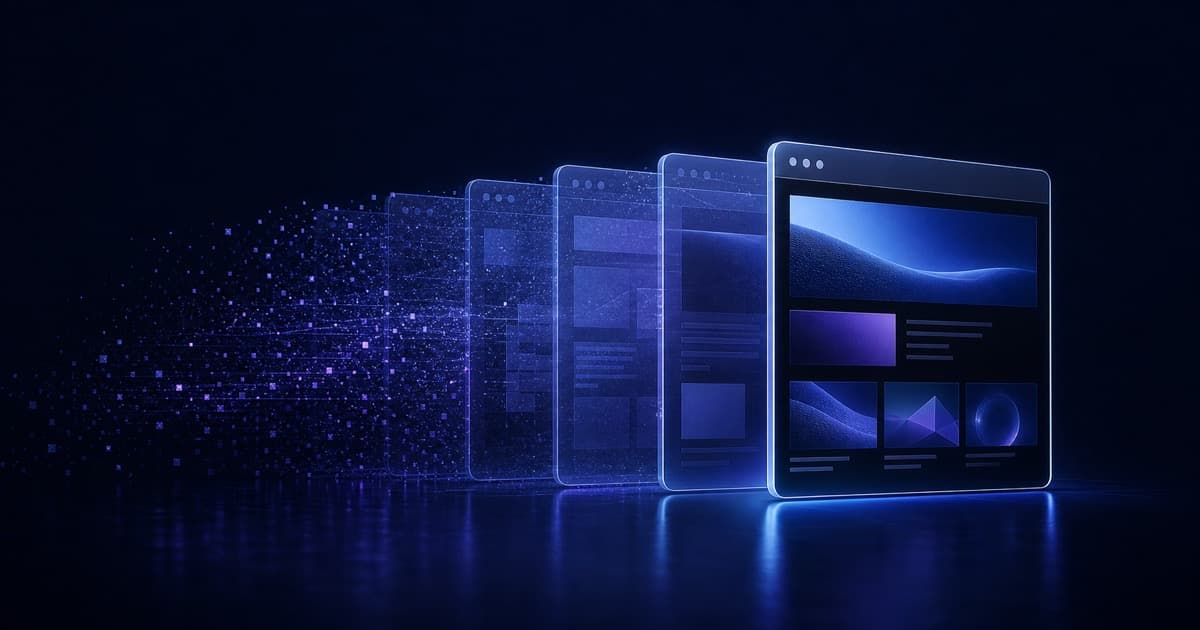
The web never stops changing.
While you're reading this article, a company is publishing a new landing page, another is updating its pricing, and a startup is rewriting the headline on its homepage. A few hours from now, many of those versions will already be gone.
Not because they failed, but simply because they were replaced.
The web was built to publish the present, not to remember the past.
Everything changes. Almost nothing remains.
A URL feels permanent. We bookmark it, share it, paste it into documents, and assume we'll always be able to come back to the exact same page.
Has it ever happened to you? You bookmark a page because of a clever headline, a specific UI component, or its overall aesthetic. Months later, you go back to use it as a reference, only to find that it has completely changed—or vanished entirely.
But a URL doesn't represent a version. It represents a current state.
Every time a page changes, the previous version quietly disappears. There is no built-in timeline, no version history, and no visual record explaining how that page evolved into what you see today.
After enough changes, we forget it was ever different.
We don't have a storage problem; we have a memory problem.
For years, the default solution to a changing web has been to save more files. We take screenshots, export PDFs, and create bloated folders called "Competitors," "Inspiration," or "Landing Pages."
But saving more files doesn't create memory.
Months later, you find those files again, but the context is gone. You no longer remember when the capture was taken, what changed afterward, what came before, or why you saved it in the first place.
The evidence survives, but the relationships are lost. Without connection, every screenshot becomes an isolated artifact—useful in the moment, but meaningless later.
A screenshot doesn't tell the whole story
A screenshot is still one of the fastest ways to capture a website. It's easy to create, easy to share, and perfect for documenting a quick design review. But a website is more than a single image.
A page has structure, metadata, interactions, and a product strategy. A screenshot freezes only what you can see. It doesn't preserve everything that moment represents, and more importantly, it doesn't connect that moment to what came before or what comes after.
Capturing is an action. Preserving is an intention.
A capture answers: "I want to save this."
Preservation answers: "I want to understand this in the future."
If all you need is a static image, a screenshot is enough. But if you want to understand how a page evolved, you need history.
Every website has a story
Pricing pages change. Homepages get redesigned. Product features launch, and companies completely reposition themselves.
These changes aren't random. They are strategic decisions.
Together, these changes tell the story of how a product evolves. For product teams, they are a record of strategic shifts. For designers, they are living inspiration. For marketers, they reveal how positioning adapts to the market over time.
But this story only exists if someone preserves it before it's gone. Once a new deployment overwrites the server, reconstructing that history becomes surprisingly difficult.
From isolated files to visual timelines
Every website deserves more than a scattered collection of screenshots. It deserves a visual timeline.
Imagine Capturing a URL once. The first Capture creates its Page and preserves its first Moment. Every future Capture adds another chapter. Instead of collecting disconnected images, you gradually build a complete history of how that Page evolved.
When you build a timeline, screenshots stop being isolated files. They become part of something much larger—a sequence you can explore, compare, share, and revisit months or even years later.
Time creates value. A screenshot taken today may seem ordinary, but six months later, it explains a crucial product decision. Two years later, it documents the evolution of an entire category.
Why this matters now
The web changes faster than ever. Product teams ship continuously, marketing teams rewrite copy weekly, and experiments appear and disappear without announcements.
Ironically, this rapid iteration makes history more valuable than ever.
A homepage isn't just a homepage; it's a record of product strategy. A pricing page isn't just pricing; it's evidence of a business decision. A redesign isn't just aesthetics; it's a snapshot of how a company thinks at a specific moment in time.
But none of that exists tomorrow unless someone preserves it today. History cannot be recreated afterward. It has to be built while it is happening, one capture at a time.
The web was built to change. That is what makes it extraordinary. Every deployment pushes ideas forward. But it has never been particularly good at remembering.
Every website tells a story.
The only question is whether anyone will still be able to read it tomorrow.